


Indexing


Journal Cover

A Comparative Study Between Grafting and Mechanical Inoculation Mediated Transmission of Tomato Yellow Leaf Curl Virus in Tomato (Solanum lycopersicon) Cultivars Grown in Ghana
Abstract
Global tomato production is seriously limited by the Tomato Yellow Leaf Curl Virus (TYLCV), leading to food insecurity globally. We studied the responses of six tomato cultivars to mechanical inoculation and grafting modes of TYLCV transmission in Ghana. Post mechanical inoculation and grafting mediated transmission resulted in upward leaf curl, stunted growth, and reduction in plant height, suggesting a successful transmission by both methods. However, disease symptom severity varied depending on the tomato cultivar as well as the mode of transmission. Transmission via grafting was more efficient in disease transfer, resulting in higher disease severity compared to those infected via mechanical inoculation. The presence of TYLCV decreased plant height and internode length regardless of the mode of transmission. TYLCV significantly decreased chlorophyll content over the controls but increased proline content than the controls. Correlation analysis revealed both positive and negative relationships between the methods of TYLCV transmission and the morphological traits of the plants studied. A strong positive correlation was observed in chlorophyll content by grafting, while plant height positively correlated with mechanical inoculation (r = 0.973). We conclude that the grafting mode of transmission is more effective than mechanical inoculation and could be used to study the propagation of phloem-limited TYLCV viruses in epidemiological studies for effective management.
Keywords: Chlorophyll; Grafting; Mechanical inoculation; Proline; Tomato yellow leaf curl virus; Tomato
A Comparative Study Between Grafting and Mechanical Inoculation Mediated Transmission of Tomato Yellow Leaf Curl Virus in Tomato (Solanum lycopersicon) Cultivars Grown in Ghana
Lordina Blessing Gyasi1, Andrew Sarkodie Appiah2, Wonder Nunekpeku2, Samuel Amiteye3, Kenneth Danso3 and Kwadwo Owusu Ayeh1*
1Department of Plant and Environmental Biology, School of Biological Sciences, University of Ghana-Legon, PO BOX LG 55 Legon, Ghana
2Biotechnology and Nuclear Agriculture Institute, Ghana Atomic Energy Commission, Kwabenya, Ghana
3Graduate School of Nuclear and Allied Sciences, University of Ghana, Accra, Ghana
*For correspondence: koayeh@ug.edu.gh
Received 31 October 2024; Accepted 09 August 2025; Published online 22 September 2025
Editor: Noreen Zahra
Abstract
Global tomato production is seriously limited by the Tomato Yellow Leaf Curl Virus (TYLCV), leading to food insecurity globally. We studied the responses of six tomato cultivars to mechanical inoculation and grafting modes of TYLCV transmission in Ghana. Post mechanical inoculation and grafting mediated transmission resulted in upward leaf curl, stunted growth, and reduction in plant height, suggesting a successful transmission by both methods. However, disease symptom severity varied depending on the tomato cultivar as well as the mode of transmission. Transmission via grafting was more efficient in disease transfer, resulting in higher disease severity compared to those infected via mechanical inoculation. The presence of TYLCV decreased plant height and internode length regardless of the mode of transmission. TYLCV significantly decreased chlorophyll content over the controls but increased proline content than the controls. Correlation analysis revealed both positive and negative relationships between the methods of TYLCV transmission and the morphological traits of the plants studied. A strong positive correlation was observed in chlorophyll content by grafting, while plant height positively correlated with mechanical inoculation (r = 0.973). We conclude that the grafting mode of transmission is more effective than mechanical inoculation and could be used to study the propagation of phloem-limited TYLCV viruses in epidemiological studies for effective management.
Keywords: Chlorophyll; Grafting; Mechanical inoculation; Proline; Tomato Yellow Leaf Curl Virus; Tomato
Introduction
Tomato production is affected by various viruses, among which the most severe and common is the Tomato Yellow Leaf Curl Virus (TYLCV), posing a significant threat to tomato cultivation (Henghui and Wei 2025). It is a highly destructive pathogen causing significant economic losses (Azaryan et al. 2024). It has been reported that the Tomato Yellow Leaf Curl Virus (TYLCV) transmitted by Bemisia tabaci is one of the severest viral diseases that has plagued the tomato plant (Piedra-Aguilera et al. 2019), leading to low yields. In Ghana, it has been estimated that the average yield of the crop is considerably low (7.85 MT/ha) compared to 15 MT/ha per ha globally (Ghana Export-Import Bank Agri-Commodity Digest Newsletter 2024). Both biotic and abiotic factors, such as pests and diseases, have contributed to the low production of tomatoes in Ghana (Abdul-Rahaman and Gambrah 2023).
Symptoms of TYLCV disease consist of upward curling of leaflet margins, yellowing and reduction of leaflet area, stunted growth, and flower abortion, leading to fewer fruit production with reduced market value. Plant viruses are known to damage the chloroplast functioning within host cells, disintegrate the development of thylakoid lamellae, and induce the production of vesicles of the outer membrane, resulting in changes of chloroplast tissues (Liang et al. 2017). Chlorophyll breakdown as a result of viral infection leads to plant senescence, a phenomenon related to shorter fruit life and immature death of plants (Oda-Yamamizo et al. 2016). This makes Tomato Yellow Leaf Curl Disease one of the most serious threats to global tomato production (Péréfarres et al. 2012; Rojas et al. 2018; El-Sappah and Rather 2021). It is estimated that in the tropical and subtropical regions, TYLCV disease can lead to total crop failure (100% yield loss) (Cathrin and Ghanim 2014).
The transmission of most plant viruses depends on vectors such as parasitic fungi, root nematodes, mites and insects (Ziegler-Graff and Brault 2008; Blanc et al. 2011). Tomato yellow leaf curl disease (TYLCD), is phloem-limited and is exclusively transmitted by the whitefly Bemisia tabaci in a persistent circulative non-propagative manner from phloem to phloem (Kil et al. 2016). Some viruses can also be mediated by the sap of virus-infected plants (mechanical transmission), vegetative propagation and grafting. According to El-Sappah and Rather (2021), inoculating tomato plants with TYLCV through grafting exposes test plants to high concentrations of viral inoculum, thus making it suitable for testing resistance or tolerance to varietal lines. Mechanical inoculation of viruses involving grinding up infected plant material and then physically applying it to the healthy plant plays a crucial role in understanding how plant viruses spread and how they can be controlled. Although, TYLCV is seedborne, it is not seed transmitted in tomato suggesting that seed-to-progeny transmission is not a general property of TYLCV (Perez-Padilla et al. 2019). In this study, we tested the infectivity of TYLCV using grafting and mechanical inoculation. The aim is to use these two modes of transmission techniques to determine host specificity of the virus.
Materials and Methods
Study area and planting materials
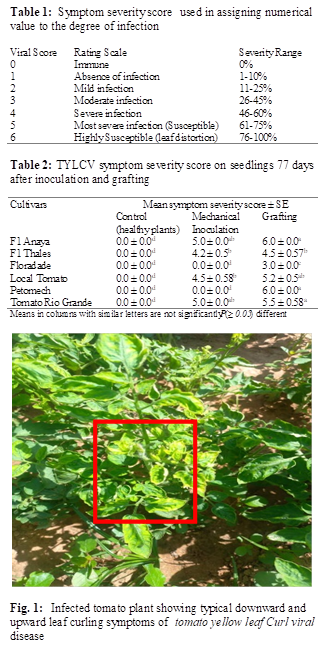
Six commercially grown tomato cultivars in Ghana namely, F1 Thales, F1 Anaya, Petomech, Tomato Rio Grande, Floradade and Local Tomato were used for this study. Viable seeds were obtained from Agriseed Limited (Ltd.) in Accra, Ghana. The infected plant materials with visible symptoms of leaf curling downwards and upwards were obtained from West African Centre for Crop Improvement (WACCI), University of Ghana agricultural fields (Fig. 1). Sap from donor plants were tested for the presence of TYLCV at the Plant Disease Research Centre-Biotechnology and Nuclear Agriculture Institute, Ghana Atomic Energy Commission, Kwabenya-Ghana using the Polymerase Chain Reaction method. The study was conducted twice between January 2023 and October 2023 in the screen house of the Department of Plant and Environmental Biology, University of Ghana (Latitude 50 39’ 13.4” N; Longitude 0” 11’ 07 7” W).
Soil preparation
The soil type used in this study was Haatso – Nyibgenya Series, obtained from the teaching garden in the Department of Plant and Environmental Biology, University of Ghana garden and sterilized at a temperature of 120°C and a pressure of 15 psi for 20 min. 30 g of soil was weighed and placed into polythene bags of dimension 20 x 30 cm. Seedlings were placed on a cement platform in the Screenhouse of the Department of Plant and Environmental Biology, University of Ghana at temperature of 33°C and 75% relative humidity.
Experimental design and mode of virus transmission
Fourteen (14) days old seedlings were used for both the mechanical inoculation and grafting to study the mode TYLCV transmission. A total of 90 tomato seedlings were used for the experimental set up under screen house conditions at 12 h/12 h (light/dark) photoperiod. 45 plants were each used for the mechanical and grafting experiments. The grafting experiment was done following the method described by Kashina et al. (2007). Susceptible TYLCV-infected tomato plants were used as scions. The scions were trimmed to make shallow incision on one side before they were gently inserted into the incision made on the understock stem of the tomato cultivars. The graft was secured using rubber strips and covered with a plastic bag as described by Spano et al. (2023). For mechanical inoculation, the method described by Hull (2009) was used. An inoculation buffer consisting of 500 ml of distilled water into which 20.214 g of NaH2PO4.H2O was added and stirred using magnetic stirrer. After thoroughly mixing, 3.394 g of Na2HPO4 was added to the solution and again stirred for 5 minutes. The solution was made up to a final volume of 1 L using sterile distilled water and pH adjusted to 7.4. Healthy uninfected leaves of tomato test plants were rubbed with sap obtained from leaf tissues of systemically susceptible TYLCV-infected tomato plants grounded in the prepared inoculation buffer and rubbed with celite. For the controls, healthy seedlings were neither grafted nor mechanically inoculated.
Growth Parameters Assessment
Viral symptom severity score
After the grafting and mechanical inoculation, TYLCV symptoms were scored both in mechanical inoculation and grafting experiments based on modified visual assessment using a scale of 1 to 6, where 0 is immune, 1 is absence of symptoms, 2 is mild infection, 3 is moderate infection, 4 is severe infection, 5 is most severe infection and 6 is highly susceptible as described by the International Institute of Tropical Agriculture (IITA) (Table 1).
Measurement of plant height, internode length and estimation of flowering time
Plant height was measured using a metre rule to measure the length of the shoot from ground level to the tip 77 days after inoculation (DAI). The internode length was also measured using a metre rule 77 DAI in both grafted and mechanically inoculated plants. The number of days for the appearance of the first flower was also recorded. State the number of replicates in each measurement.
 Determination of chlorophyll content
Chlorophyll content was determined on three leaves obtained from both grafted and mechanically inoculated plants using the Spectra Absorbance Data (CCM-200 Chlorophyll Content Meter (Opti-Sciences, Hudson-USA) 100 DAI. The chlorophyll content was determined every week for four (4) consecutive weeks 100 days after the inoculation.
Determination of proline content
Proline content was determined using a modified method described by Bates et al. (1973). Two hundred and fifty (250 mg) of leaf samples taken from both grafted and mechanically inoculated plants were ground in 10 mL of 3 % sulphosalicyclic acid. The solution was then centrifuged at 33000 rpm for 10 min and 2 mL of supernatant was transferred into clean test tubes. Two (2 mL) of 6 M orthophosphoric acid, 2 mL of acid ninhydrin and 2 mL of glacial acetic acid were added to the supernatant and kept in a water bath for an h at 100°C. The resulting solution was then transferred into a separation funnel and 4 mL of toluene solution was subsequently added. After shaking carefully, the supernatant was collected and placed in an ultraviolet spectrophotometer and values read at 520 nm. Proline standards at different concentrations were prepared and proline content was calculated using the formula:
Proline content (µg/g Fw) = Absorbance/2 × 10/250×1000
Statistical analysis
The experiments in the screen house were carried out using Randomized Complete Block Design (RCBD) with five replicates. Analysis of variance was done using the Minitab Software (Version 17). Where ANOVA was significant, Tukey-pairwise comparison was used for mean separation. Pearson correlation coefficients were used to determine relationship between height and TYLCV transmission (Meena and Bahadur 2014).
Results
TYLCV disease symptom score
No virus symptoms
were observed in any of the healthy tomato plants in grafted mode of virus
transmission (Fig. 2a) as compared to disease plants under grafting method of
virus transmission (Fig. 2b). Further in the mechanical inoculated method of virus transmission no virus symptom was produced
in healthy plants (Fig. 3a). Suffice to say, plants also showed TYLCV symptoms
in mechanical method of virus transmission (Fig. 3b), suggesting that the two
methods allowed the transmission of the virus from plant to plant (Table 2). The
degree of symptom severity was more pronounced in grafted plants (Fig. 3c) than
mechanically inoculated virus plants. The days for symptom expression, however,
varied between the two methods. For grafted plants, symptoms were
first observed 35 days after grafting while for mechanical inoculation symptoms
were observed 77 days after inoculation. For mechanical inoculation, symptom
severity score ranged from no infection (0) in Floradade and Petomech to 5.0 in
F1 Anaya and Tomato de Grande. Contrastingly, the grafting method allowed
transmission in all the six varieties suggesting that it is more efficient in
viral transmission than the mechanical inoculation method. The highest symptom
severity score (6.0 ± 0.0) was observed in F1 Anaya and Petomech tomato
cultivars while the least symptom severity score (3.0) was observed in Floradade. 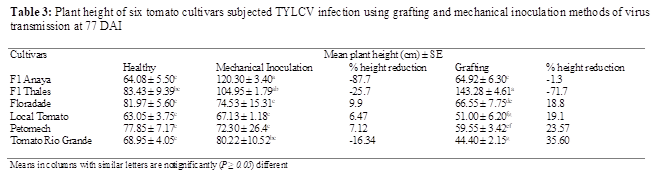 The control plants (healthy) did not show any symptoms of
TYLCV disease. In both methods, significant (P ≤ 0.05) differences in
symptom severity between cultivars were observed. The symptom severity scores
also showed that grafted plants were more
infected with TYLCV than mechanical inoculation.
The control plants (healthy) did not show any symptoms of
TYLCV disease. In both methods, significant (P ≤ 0.05) differences in
symptom severity between cultivars were observed. The symptom severity scores
also showed that grafted plants were more
infected with TYLCV than mechanical inoculation.
Plant height
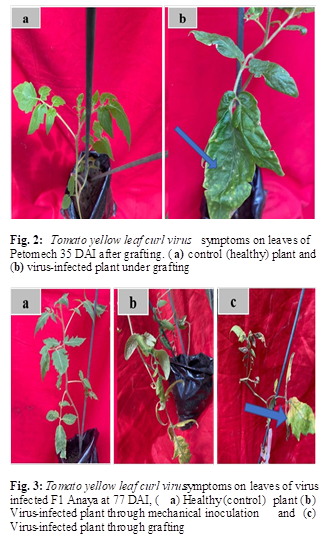
Plant height of the tomato cultivars subjected to mechanical inoculation and grafting were measured to compare the effectiveness of the two modes of transmission of TYLCV 77 DAI in tomato plants (Table 2). The height of the plants varied significantly (P ≤ 0.05) depending on the cultivar as well as the modes of transmission. For healthy plants (controls), the height of the plants ranged from 63.05 cm in Local tomato to 83.43 cm in F1 Thales cultivars which was slightly significant from the remaining cultivars. Of the two treatments, plants infected using mechanical inoculation grew taller than their respective counterparts infected via grafting except for F1 Thales which had the tallest plants (143.28 cm). The height of plants infected with TYLCV via mechanical inoculation ranged from 67.13 cm in Local tomato to 120.30 cm in F1 Anaya suggesting genotypic differences while for grafting, plant height after infection ranged from 44.40 cm in Tomato Rio Grande to 143.28 cm in FI Thales. The percentage height reduction after infection using both transmission modes did not show the expected growth reduction trend in all cultivars. In both mechanical inoculation and grafting, F1 Anaya and F1Thales grew taller after infection with the virus regardless of the mode of transmission. The same observation was made when Tomato Rio Grande plants were infected via mechanical inoculation. Consequently, the calculated height reduction in these two cultivars is negative ranging from -16.34% to -87.7% and -1.3% to -87.7% for plants infected via mechanical inoculation and grafting respectively (Table 3). Also, with the exception of F1 Anaya and F1 Thales, the percentage height reduction was comparatively higher when plants were infected via grafting than mechanical inoculation. In Floradade, the percentage height reduction in plants infected via grafting was twice that of those infected through mechanical inoculation while in both Local tomato and Petomech, the percentage height reduction in grafting was three times those of mechanical inoculation.
Internode length
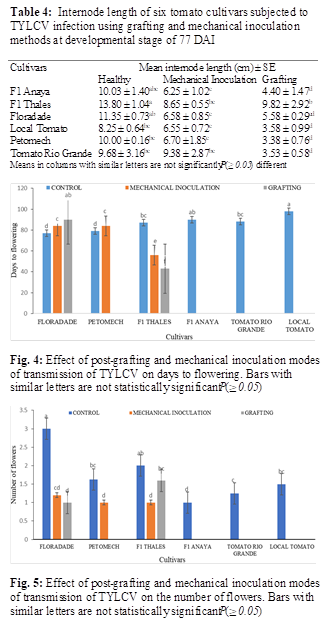 Table 4 shows the effect of TYLCV disease after infection
through mechanical inoculation and grafting methods on the length of internode
in the five tomato cultivars. Unlike the plant height, the effect of the virus on the internodes showed the expected
trend with the controls (healthy plants) showing longer internodes than the
virus infected plants. The severest effect of the virus was observed in Petomech
shown by internode length of 3.38 cm when plants were infected via
grafting. For mechanical inoculation, the severest effect of the virus was
observed in Local tomato cultivar shortening the internode from 8.25 cm in the
controls to 6.55 cm. Independent of the mode of transmission, the viral infection
in F1 Anaya, F1 Thales, and Floradade differed significantly (P ≤ 0.05)
from the remaining cultivars (Table 4). Generally, the effect of the virus on shortening
of internodes in plants infected via grafting was severe than those infected by
mechanical inoculation.
Table 4 shows the effect of TYLCV disease after infection
through mechanical inoculation and grafting methods on the length of internode
in the five tomato cultivars. Unlike the plant height, the effect of the virus on the internodes showed the expected
trend with the controls (healthy plants) showing longer internodes than the
virus infected plants. The severest effect of the virus was observed in Petomech
shown by internode length of 3.38 cm when plants were infected via
grafting. For mechanical inoculation, the severest effect of the virus was
observed in Local tomato cultivar shortening the internode from 8.25 cm in the
controls to 6.55 cm. Independent of the mode of transmission, the viral infection
in F1 Anaya, F1 Thales, and Floradade differed significantly (P ≤ 0.05)
from the remaining cultivars (Table 4). Generally, the effect of the virus on shortening
of internodes in plants infected via grafting was severe than those infected by
mechanical inoculation.
Days to flowering
The effect of TYLCV infection on flowering in six tomato cultivars is shown in Fig. 4. All the controlled healthy plants flowered while three of the infected cultivars (F1 Anaya, Rio De Grande and Local tomato did not flower during the study period. Of the three remaining cultivars, Petomech plants infected via grafting did not also flower. The days to flowering varied depending on the cultivar as well as the mode of the transmission of the virus. The days to flowering was delayed in Floradade (84 days) and Petomech (85 days) plants infected via mechanical inoculation compared to the controls (76 days) while in F1 Thales, flowering was earlier (52 days) when plants were infected either via mechanical inoculation or grafting.
Number of flowers
All controlled healthy plants produced flowers while three of the virus infected plants (F Anaya, Tomato Rio Grande and Local tomato) did not produce flowers. Of those cultivars which produced flowers, the controls significantly (P ≤ 0.05) produced more flowers than the infected plants. In Petomech, grafted mediated transmission of TYLCV did not produce flowers throughout the study period. The number of flowers produced by the virus infected plants varied depending on the cultivar. In Floradade, the number of flowers produced by mechanical inoculation (1.25) was comparatively higher than grafted mediated (1.8) transmission while in F1 Thales, grafted mediated transmission significantly produced more flowers per plant than mechanical inoculation (Fig. 5).
Chlorophyll content
The effect of the
virus on chlorophyll content after transmission was studied using Spectra
Absorbance Data and the results are graphically presented in Fig. 6. The
chlorophyll content in all the healthy controlled plants was more than 10 mg/m2
which was significantly (P ≤ 0.05) higher than the infected plants.
Also, in most cultivars, it was more than double the infected plants. Local
tomato and Floradade controls had the highest chlorophyll content among all the
cultivars. Of the infected plants, mechanical inoculation mediated transmission
was higher than grafting. In Floradade and F1 Thales the effect of the virus via
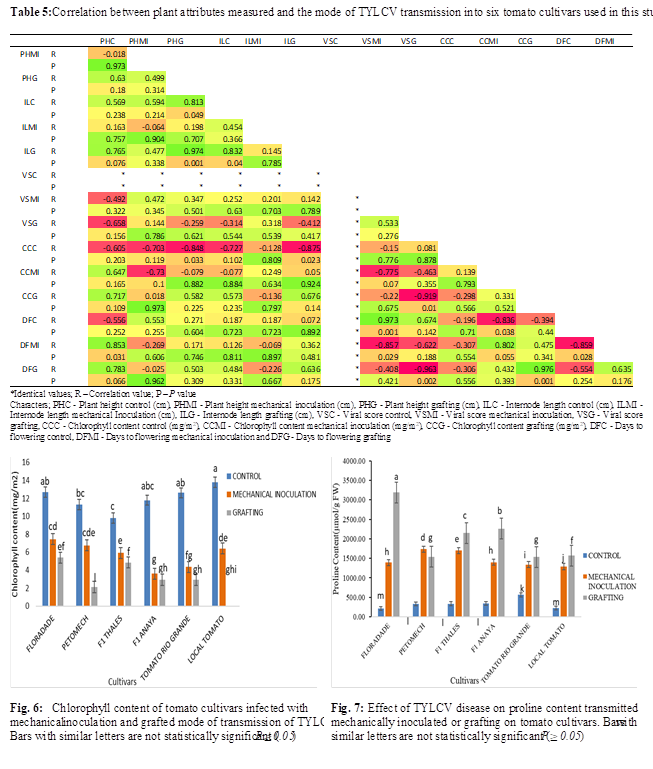 mechanical inoculation was highly significant than the
grafted method. For the remaining cultivars the differences between mechanical
inoculation and the grafted method are slightly significant. The chlorophyll
contents of TYLCV infected local tomato via grafting were below a detectable threshold.
mechanical inoculation was highly significant than the
grafted method. For the remaining cultivars the differences between mechanical
inoculation and the grafted method are slightly significant. The chlorophyll
contents of TYLCV infected local tomato via grafting were below a detectable threshold.
Proline content
The proline content in all the healthy plants was significantly lower than the infected plants regardless of the mode of transmission; it was below 500 µmoL/gFW except in Tomato Rio Grande (500 µmoL/gFW). Contrastingly, the proline content of the TYLCV infected plants via grafting was significantly higher than the mechanical inoculation method ranging from 1500 µmoL/gFW in Tomato Rio Grande to 3250 µmoL/gFW in Floradade. For the mechanical inoculated method, the proline content ranged from 1350 µmoL/gFW in local tomato to 1750 µmoL/gFW in Petomech (Fig. 7).
Correlation analysis was done to determine the extent of relationship between the morphological traits of the plants and the effect of the virus transmitted via mechanical inoculation or grafting and the results are tabulated in Table 5. There were both positive and negative correlation between control, mechanical inoculation and grafting under plant height, internode length, viral score, chlorophyll content and days to flowering. A strong positive correlation was seen in the interaction between internode length through mechanical inoculation (ILMI) and plant height through mechanical inoculation (PHMI) (r = 0.904). This strong correlation was mirrored in chlorophyll content through grafting (CCG) and plant height through mechanical inoculation (PHMI) (r = 0.973). In addition, days to flowering obtained by grafting (DFG) and plant height through mechanical inoculation (PHMI) equally showed a positive correlation (r = 0.962). Interestingly, chlorophyll content through grafting (CCG) negatively correlated with viral symptom score through grafting (VSG) (r = -0.919). Similar observation was seen in days to flowering through grafting (DFG) and chlorophyll content through grafting (CCG) (r = -0976).
Plant height under mechanical inoculation (PHMI) showed a moderate positive correlation towards plant height through grafting (r = 0.499), internode length-control (r = 0.594), internode length through grafting (r = 0.477), viral score-mechanical inoculation (r = 0.472) and days to flowering-control (r = 0.553). Likewise, a moderate positive relationship was observed between plant height, chlorophyll content (r = 0.582) and days to flowering (r = 0.503) under grafting (Table 5). Plant height-control (PHC) also showed a moderate positive relationship towards plant height-grafting whereas plant height grafting gave a strong negative correlation with plant height control (r = -0.658). A similar correlation was observed between internode length-control (ILC), internode length-mechanical inoculation (ILMI) (r = 0.454) and chlorophyll content-grafting (CCG) (r = 0.573), viral score grafting (VSG) and mechanical inoculation (r = 0.533), chlorophyll content-mechanical inoculation (CCMI) and days to flowering-grafting (r = 0.432), chlorophyll content-grafting (CCG) and days to flowering-mechanical inoculation (DFMI) (r = 0.475).
Plant height under control (PHC) showed a moderate negative correlation towards viral score-mechanical inoculation (VSMI) (-0.492) and days to flowering-control (-0.556) and a very weak positive and negative correlation towards internode length (r = 0.163) and plant height (-0.018) under mechanical inoculation, respectively.
Discussion
Tomato Yellow Leaf Curl Virus (TYLCV) is one of the most devastating viral diseases in tomato, posing a serious threat to food security globally. It is vectored by Bemissia tabaci and it is symptomatically expressed as upward leaf curling, cupping with or without marginal chlorosis, smaller leaflets and stunted growth, thereby leading to reduced yield. In the present study, the leaves of tomato plants infected with TYLCV via mechanical inoculation or grafting showed these symptoms, indicating successful transmission by both methods. However, days to transmission and disease symptom severity varied depending on the mode of transmission. Grafting mediated transmission comparatively showed earlier symptom expression and higher symptoms severity than mechanical inoculation. Several authors have reported that grafting-mediated TYLCV transmission is more efficient than mechanical inoculation. Lee et al. (2017) reported that single leaflet grafting in tomato is an efficient method for transmitting Tomato Chlorosis Virus (ToCV) and TYLCV, providing a reliable inoculation technique for research. Tomato yellow leaf curl disease is phloem limited (Cathrin and Ghanim 2014) and its efficient transmission via grafting may be attributed to continuous exposure of a recipient plant to a high level of inoculum once the vascular system between the scion (recipient) and the rootstock (source) is connected. Consequently, grafting has been used to transmit several viral pathogens, as mechanical inoculation does not readily transmit them (Mirzayeva and Huseynova 2024). Thus, grafting has been applied for the inoculation of various viral pathogens that are not easily transmissible by mechanical inoculation (Lee et al. 2017).
The severity of disease symptoms can represent the degree of plant tolerance and/or tolerance to a disease. We observed that the six tomato cultivars used in the study differed in their symptom severity suggesting that their tolerance and/or susceptibility to the TYLCV viruses also differed. Floradade showed the least disease severity suggesting that it was tolerant, while F1 Anaya and Petomech exhibited high symptom severity score suggesting that they are highly susceptible to the virus. The observed differences could be attributed to cultivar specificity as well as the inherent genetic constitution of the individual tomato cultivars. Domesticated tomato Solanum lycopersicum, is highly susceptible to the TYLCV causing total crop failure in several cultivars, thus there is the need to breed for highly tolerant cultivars by introgression of tolerant genes into susceptible cultivars. Recent breeding efforts have released several commercially available TYLCV-resistant cultivars (Dhaliwal et al. 2020). However, these resistance cultivars are not immune to the virus and accumulate TYLCV, which make them exhibit mild symptoms or no symptoms at all following TYLCV infection (HEl-Sappah et al. 2022).
The successful transmission of the TYLCV virus via grafting subsequently led to significantly impaired growth by decreasing the plant height and internode length. Earlier studies by Vitti et al. (2016) and Villalón et al. (2018) also revealed similar reduction in plant height by viruses in Trichoderma harzianum. The transmitted viruses imposed biotic stress on the plants resulting in decreased growth and development due to inhibition of cell division and differentiation in the shoot apical meristem (Bradamante et al. 2021). Choe et al. (2021) hypothesized that TYLCV -induced symptoms leading to impairment of plant growth and development might be directly associated with the suppression of cellulose synthesis genes.
Post viral transmission of TYLCV significantly reduced the chlorophyll content in all the six cultivars independent of the mode of transmission, although the reduction was comparatively higher in mechanical inoculation than grafting. Bellah et al. (2023) have reported that plant viruses destroy the structure and function of host tissues and organelles, prevent the normal physiological development of the host, causes a rise in the activity of chlorophyll-degrading enzymes and decreases chlorophyll content. The reduction in chlorophyll content reduces the photosynthetic efficiency of the virus infected host plants. Infected tomato plants with Tomato yellow mosaic virus (TYMV) have been found to cause a reduction in photosynthetic rate and an increase in respiration (Montasser et al. 2012).
Proline is known to protect the plant under stress conditions as it maintains the integrity of the cell membrane by balancing the change in the turgor pressure due to pathogenic infection (Singh et al. 2021). We therefore studied the effect of the TYLCV on the proline content of the infected plant. The proline content was significantly higher in the infected plants regardless of the mode of transmission than the controls. These findings were similar to those of Bassiouny et al. (2015) who reported that tomato plants infected with TYLCV led to a significant increase in proline content. Proline is a stress marker in plants, playing a role in scavenging hydroxyl radicals and helping plants resist stress. TYLCV infection triggers this increases as part of the plant's defense response to the viral stress (Mishra et al. 2022).
Correlation studies revealed that both grafting and mechanical inoculation modes of virus transmission improved plant attributes through the strong positive correlation observed in this study. It appears that the exact relationship between modes of virus transmission and plants attributes (measurements) seen in this study may be obscure and yet to be verified. Nevertheless, individual varietal responses may account for the differences seen in the mechanism of viral transmission and plant attributes observed in this study. Further, chlorophyll content through grafting seems to expose tomatoes cultivars to high viral load which negatively impacted chlorophyll content. In related research, chlorophyll contents were found to be negatively correlated to viral load in Brassica after Turnip mosaic virus infection (De-Ping Guo 2005). Plant viruses have a pronounced effect on plant height because viruses impair meristematic activity leading to stunted growth. Iftikhar et al. (2021) reported related findings in tomatoes where strong negative correlation was found to exist between tomato leaf curl virus disease incidence and plant height.
Conclusion
Both grafting and mechanical inoculation allowed successful transmission of Tomato Yellow Leaf Curl Virus (TYLCV) to non-infected plants. Nevertheless, virus transfer to healthy plants was more efficient in grafting than mechanical inoculation. The successful transmission via grafting could be used for propagation and management of the virus. The incidence of the disease varied depending on the tomato cultivar as well as the mode of transmission. The high symptom severity resulted in reduced chlorophyll content which may have adverse effect on photosynthetic efficiency and yield. Floradade with low disease incidence could be used in tomato breeding programmes to breed for TYLCV tolerance varieties to benefit farmers.
Acknowledgements
The authors are thankful to the Department of Plant and Environmental Biology, the Biotechnology and Nuclear Agriculture Research Institute (BNARI-GAEC) assisting with necessary resources and equipment for the experiment.
Authors' Contributions
Conceptualization: KOA, LBG and ASA. Methodology: ASA, KOA and LBG. Investigation: KOA, LBG and ASA. Original Draft: LBG and KOA. Formal analysis: LBG, ASA, WN and KOA. Writing, review and editing: LBG, KOA, ASA, WN, SA and KD.
Conflict of Interest
The author(s) declare(s) that they have no competing interests.
Data Availability
The reported data can be made available upon requesting to the corresponding author.
Ethics Approval
Not applicable to this study.
Funding Source
The study did not receive any funding.
References
Abdul-Rahaman AS, PP Gambrah (2023). Local trade networks among farmers and traders. Soc Network 12:93–110 https://doi.org/10.4236/sn.2023.124006
Azaryan A, MR Atighi, M Shams-Bakhs (2024). Infection of tomato plants by tomato yellow leaf curl virus (TYLCV) potentiates the ethylene and salicylic acid pathways to fend off root-knot nematode (Meloidogyne incognita) parasitism. Plant Physiol Biochem 217:109271 ISSN 0981-9428, https://doi.org/10.1016/j.plaphy.2024.109271
Bassiouny FM, RR Khalil, KA El-Dougdo, S Abo-Elmaty, MS Yousef (2015). Geminivirus modified antioxidant systems and proline accumulation in tomato plant. J Funct Environ Bot 5:1-11
DOI: 10.5958/2231-1750.2015.00005.0
Bates LS, RP Waldren, ID Teare (1973). Rapid determination of free proline for water-stress studies. Plant Soil 39:205–207
Bellah H, NF Seiler, D Croll (2023). Divergent outcomes of direct conspecific pathogen strain interaction and plant co-infection suggest consequences for disease dynamics. Microbiol Spectr 11:1-15
Blanc S, M Uzest, M Drucker (2011). New research horizons in vector-transmission of plant viruses. Curr Opinion Microbiol 14:483–491
Bradamante GM, O Scheid, M Incarbone (2021). Under siege: Virus healthy in plant meristems and progeny. Plant Cell 33:2523–2537 https://doi.org/10.1093/plcell/koab140
Cathrin, PB, M Ghanim (2014). Recent advances on interactions between the whitefly bemisia tabaci and begomoviruses, with emphasis on Tomato Yellow Leaf Curl virus. In: Plant Virus–Host Interaction: Molecular approaches and viral evolution, pp:79–103. Gaur RK, T Hohn, P Sharma (Eds.). Academic Press https://doi.org/10.1016/b978-0-12-411584-2.00004-4
Choe S, B Choi, JH Kang, JK Seo (2021). Tolerance to tomato yellow leaf curl virus in transgenic tomato overexpressing a cellulose synthase-like gene. Plant Biotechnol J 19:657-659
De-Ping G, G Yan-Ping, Z Jian-Ping, L Hui, P Yan, W Qiao-Mei, C Ji-Shuang, R Gui-Zhen (2005). Photosynthetic rate and chlorophyll fluorescence in leaves of stem mustard (Brassica juncea var. tsatsai) after turnip mosaic virus infection. Plant Sci 168:57-63
Dhaliwal MS, SK Jindal, A Sharma, HC Prasanna (2020). Tomato yellow leaf curl virus disease of tomato and its management through resistance breeding: a review. J Hortic Sci Biotechnol 95:425–444
Ghana Export-Import Bank Agri-Commodity Digest Newsletter (2024). In: Ghana EXIM Bank, Vol. 1, pp:1-30.
Available at: https://eximbankghana.com/wp-content/uploads/2024/05/9dd0bc8a7de14624b4a53e15c65243b7-compressed-eb71480c2580756980bb6ab39ce3a269.pdf
El-Sappah AH, SA Rather (2021). Genomics approaches to study abiotic stress tolerance in plants. In: Plant Abiotic Stress Physiology, pp:25–46. Apple Academic Press https://doi.org/10.1201/9781003180579-2
HEl-Sappah A, SA Qi, S Soaud, Q Huang, M Saleh, AASM Abourehab, L Wan, G Cheng, J Liu, M Ihtisham, Z Noor, R Rouf Mir, X Zhao, K Yan, M Abbas, J Li (2022). Natural resistance of tomato plants to tomato yellow leaf curl virus. Front Plant Sci 13:1-22 https://doi.org/10.3389/fpls.2022.1081549
Henghui M, L Wei (2025). Tomato yellow leaf curl virus detection based on cross-domain shared attention and enhanced BiFPN. Ecol Inform 85:102912 ISSN1574-9541, https://doi.org/10.1016/j.ecoinf.2024.102912
Hull R (2009). Mechanical inoculation of plant viruses. Curr Protoc Microbiol 13:166
Iftikhar Y, M Mubeen, A Sajid, MA Zeshan, Q Shakeel, A Abbas, S Bashir, M Kamran, H Anwaar (2021). Effects of Tomato Leaf Curl Virus on Growth and Yield Parameters of Tomato Crop. Arab J Plant Prot 39:1-5
Kashina BD, RB Mabagala, AA Mpunami (2007). Transmission properties of tomato yellow leaf curl virus from Tanzania. J Plant Prot Res 2007:43–51
Kil EJ, S Kim, YJ Lee, HS Byun, J Park, H Seo, CS Kim, JK Shim, JH Lee, JK Kim, KY Lee, HS Choi, S Lee (2016). Tomato yellow leaf curl virus (TYLCV-IL): A seed-transmissible geminivirus in tomatoes. Sci Rep 6:1-10
Lee H, MK Kim, HS Choi, JH Kang, HJ Ju, JK Seo (2017). Efficient transmission and propagation of tomato chlorosis virus by simple single-leaflet grafting. Plant Pathol J 33:345-349
Liang QL, LX Wei, BL Xu, A Calderón-Urrea, D Xiang (2017). Study of viruses co-infecting white clover (Trifolium repens) in China. J Integr Agric 16:1990–1998
Meena, OP, V Bahadur (2014). Assessment of correlation and path coefficient analysis for yield and yield contributing traits among tomato (Solanum lycopersicum L.) germplasm. Agric Digest Sci 34:245–250
Mirzayeva S, I Huseynova (2024). A simplified single-leaflet graft inoculation method and a Duplex PCR assay for the identification of the Tomato Yellow Leaf Curl Virus infection in tomatoes
Available at: https://agris.fao.org/search/en/providers/124223/records/66d82dbff995ef9c0423f981
Mishra R, M Shteinberg, D Shkolnik, G Anfoka, H Czosnek, R Gorovits (2022). Interplay between abiotic (drought) and biotic (virus) stresses in tomato plants. Mol Plant Pathol 23:475–488
Montasser MS, FD Al-Own, AM Haneif, M Afzal (2012). Effect of Tomato yellow leaf curl bigeminivirus (TYLCV) infection on tomato cell ultrastructure and physiology. Can J Plant Pathol 34:114–125
Oda-Yamamizo C, N Mitsuda, S Sakamoto, D Ogawa, M Ohme-Takagi, A Ohmiya (2016). The NAC transcription factor ANAC046 is a positive regulator of chlorophyll degradation and senescence in Arabidopsis leaves. Sci Rep 6:1-13. https://doi.org/10.1038/srep23609
Péréfarres F, M Thierry, N Becker, P Lefeuvre, B Reynaud, H Delatte, JM Lett (2012). Biological invasions of geminiviruses: Case study of TYLCV and Bemisia tabaci in Reunion Island. Viruses 4:3665–3688
Piedra-Aguilera Á, C Jiao, AP Luna, F Villanueva, M Dabad, A Esteve-Codina, AG Castillo (2019). Integrated single-base resolution maps of transcriptome, sRNAome and methylome of Tomato yellow leaf curl virus (TYLCV) in tomato. Sci Rep 9:1-16
Rojas MR, MA Macedo, MR Maliano, M Soto-Aguilar, JO Souza, RW Briddon, RL Gilbertson (2018). World management of geminiviruses. Annu Rev Phytopathol 56:637–677
Singh YJ, SK Grewal, RK Gill (2021). Proline metabolism and phenylpropanoid pathway act independently in conferring resistance against yellow mosaic virus infection in black gram. Physiol Mol Plant Pathol 116:101713 ISSN 0885-5765, https://doi.org/10.1016/j.pmpp.2021.101713
Villalón E, DM Barry, N Byers, K Frizzi, MR Jones, DS Landayan, JM Dale, NL Downer, NA Calcutt, ML Garcia (2018). Internode length is reduced during myelination and remyelination by neurofilament medium phosphorylation in motor axons. Exp Neurol 306:158–168 https://doi.org/10.1016/j.expneurol.2018.05.009
Vitti A, E Pellegrini, C Nali, S Lovelli, A Sofo, M Valerio, M Nuzzaci (2016). Trichoderma harzianum T-22 induces systemic resistance in tomato infected by Cucumber mosaic virus. Front Plant Sci 7:1-11
Ziegler-Graff V, V Brault (2008). Role of vector-transmission proteins. In: Plant Virol Protocols: From Viral Sequence Protein Function, 2nd ed., pp:81–96
Online : 1814-9596
Print : 1560-8530